MESHCODE BLOG
Notes & guides
Getting more done with AI — tips, ideas, and what's new.
How to Write a PRD With AI (That Engineers Actually Use)
A walkthrough of turning an idea, meeting notes, or existing code into a PRD with the biz-prd skill — and the decisions no AI can make for you.
TAM, SAM, SOM With AI: Market Sizing Without a Consultant
How to triangulate a defensible market size with the biz-market-sizing skill — top-down, bottom-up, and analogous markets — plus where the estimates usually go wrong.
How to Remove AI-Sounding Writing Before You Publish
A pre-publish checklist built on two skills — copy-humanize for rhythm and cliché, copy-brand-voice for channel tone — plus the honest limits of de-AI-ing copy.
Claude Skills vs MCP Servers: Which One Solves Which Problem
Skills are instructions your agent loads; MCP servers are connections it reaches through. A one-to-one comparison — when each is the right answer, when you need both, and when neither.
Best Claude Code Skills for SEO: The Seven Worth Installing
Seven SEO skills for coding agents — what each one checks, when to reach for it, and the audit orchestrator that runs the rest in a single pass.
Run an SEO Audit Without Hiring an Agency
Agencies sell audit Reports; skill folders let you run the same check categories yourself, on a schedule you control. What that trade actually looks like, and where a human is still needed.
AI Competitor Research Without Expensive Tools
Two skills cover most competitor research needs — a systematic, evidence-graded profile and a fast URL-based teardown. How to pick, and what the output actually looks like.
How to Run Claude Code and Codex in Parallel on One Repo (Git Worktrees, Step by Step)
Run Claude Code and Codex on the same repository at once without them overwriting each other: one git worktree per agent, scoped briefs, and a safe merge. Step by step.
The Cheapest Way to Use Grok for Coding in 2026
The cheapest way to use Grok for coding depends on how you work: API tokens from about $1 per million, Cursor Pro at $20 with a dedicated Grok pool, or SuperGrok at about $30. What each route really costs.
Can You Use Claude Code and Codex at the Same Time? (2026 Guide)
Yes. Claude Code and Codex have separate logins, billing and usage limits, so you can run both on one project today. How to set it up, what goes wrong, and what it costs.
Best AI Workspaces for Running Claude Code and Codex Together (2026)
Terminal panes with git worktrees, Claude Squad, Conductor, Zed, the Codex and Claude desktop apps, Vibe Kanban and meshcode compared: what each runs, what it costs, who it fits.
What Is an AI Workspace? A Plain-English Explanation
An AI workspace is a desktop environment built around parallel agent sessions instead of one chat window — how it differs from a coding editor, and what running several agents at once actually looks like.
GitHub Copilot vs Cursor: Which Is Cheaper in 2026?
GitHub Copilot Pro is $10/month and Cursor Pro is $20 — but OpenAI's November 12, 2026 cutoff of Cursor's model access changes what cheap means. The real total cost compared.
Cursor Is Losing OpenAI Models in November 2026: What You Actually Lose and Your Options
OpenAI will cut Cursor off from its models on November 12, 2026 following SpaceX's acquisition. What Cursor users really lose, why single-vendor harnesses carry lock-in risk, and what to do before the shutoff.
Codex Weekly Quota Dropped to Zero? The Bug, the Ranges, and What to Check
A Codex weekly quota dropped from 21% to 0% while idle in GitHub issue openai/codex#44233. Decode whether disappearing quota is a bug or rolling-window mechanics, what /status shows, and what to do.
Claude Usage Credits Expire: The Six-Month Rule Explained
Claude usage credits now expire six months after purchase in certain jurisdictions such as Japan, starting September 10, 2026. What the policy says, what it means for prepaid habits, and how to budget credits vs. subscriptions.
Claude Fable 5 Explained: What It Is, What It Costs, and Why It Burns Through Limits
Claude Fable 5 explained — Anthropic's Mythos-class flagship, its $10/$50 per-million-token API pricing, why it eats plan limits unusually fast, and when a cheaper model is the smarter buy.
Claude Code vs Codex Rate Limits Compared (2026)
Claude Code runs a weekly pool plus rolling five-hour windows; Codex uses 5-hour windows with unpublished weekly caps. How both rate limits actually work after September 14, 2026.
Claude Code Usage Limit Cut in September 2026: What Changed and What Actually Helps
The Claude Code usage limit cut of September 14, 2026 replaced a temporary 50% boost with a permanent 25% raise — leaving many users with about 17% less capacity than the day before. Here's what changed, who's hit hardest, and what actually helps.
The Cheapest Way to Use Windsurf in 2026
Windsurf pricing in 2026 runs from a free tier to $20 Pro and $200 Max — but daily/weekly quotas replaced credits in March 2026. What the cheapest honest routes through Windsurf actually cost.
The Cheapest Way to Use GitHub Copilot in 2026
The cheapest way to use GitHub Copilot in 2026 ranges from the free tier to $10 Pro — but promotional credits and AI Credit billing changed the real cost. What each tier actually gets you.
The Cheapest Way to Use Claude Fable 5 in 2026
The cheapest way to use Claude Fable 5 depends on the route: Claude plan subscriptions, raw API billing at $10/$50 per million tokens, or connecting your own Claude CLI. Here's what each route actually costs.
Why One Gemini Prompt Uses Multiple Requests — and What Each One Costs
One prompt is not one model call. Agent tools send your context, call tools, and retry — several model requests per prompt. Where that's metered, why small tasks can exhaust a request quota, and how to measure your own sessions.
Whole Repo vs. Targeted Context: a Reproducible Cost Experiment You Can Run
Does feeding the whole repository to your coding agent cost more than passing only the relevant files? Here's a rigorous experiment design — worktrees, matched tasks, honest bookkeeping — you can run on your own stack.
Vibe Coding with Voice Input: When Dictating Specs Beats Typing
Dictating specs by voice speeds up scoping but fails at identifiers and paths. Here's when voice input helps and how to pair it with a written spec.
How to Migrate from Gemini CLI to meshcode: A Step-by-Step Guide
Moving from Gemini CLI to meshcode: open the repo, reconnect models, adjust to panes — plus what changes about quota and billing.
How to Price AI-Built Freelance Projects
How to price AI-built freelance projects: value-based vs hourly, a cost floor, and how to discuss AI speed with clients.
Barely Used Gemini CLI but Hit the Limit? Diagnose the Code Assist Shared Quota
When your Gemini CLI quota dies early, the cause is usually not your account — it's which meter you're on. How to tell the free consumer plan, CLI Google login, and API-key paths apart, understand the shared-quota structure, and recover without rotating accounts.
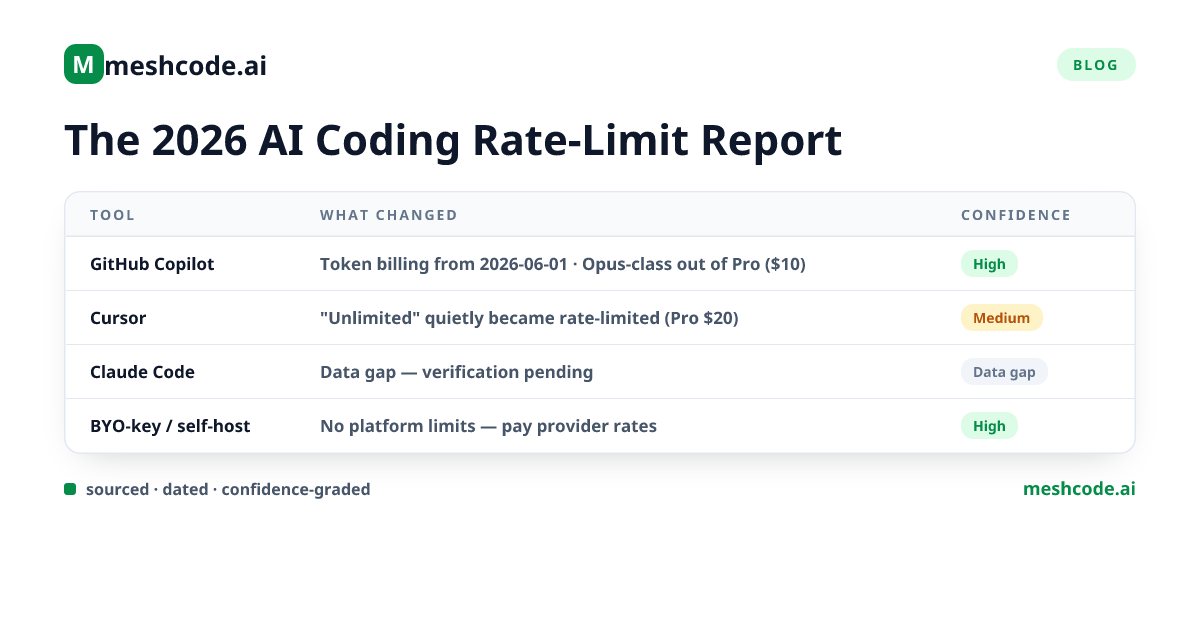
The 2026 AI Coding Rate-Limit Report
Copilot moved to token billing on 2026-06-01 — Pro ($10) lost Opus-class access. Cursor's "unlimited" became rate limits. Every figure sourced, dated, graded.
Hit Your Claude Code Usage Limit? How to Hand Off to Another Agent Without Losing the Work
A practical handoff: capture the state of your session, switch agents, and continue — without destructive git moves, shared session state myths, or losing uncommitted changes.
Build a Helpdesk Ticket Tracker with AI, Step by Step
A practical walkthrough: describe the helpdesk app, model tickets, statuses, and assignees, deploy it, then extend it with email notifications.
The Best AI Coding Agent for Consultants: Evaluation Criteria
Criteria for choosing an AI coding agent for consultants: code ownership, cost visibility, pricing model, and export of real code.
AI Coding Agent Release Notes: A Changelog Workflow That Audits Itself
Have your AI coding agent maintain the changelog as it ships. A release-notes workflow creates the audit trail AI-written code reviews actually need.
AI Coding Agent for Trades and Home Services
Plumbers, electricians, and HVAC crews can build quote calculators, booking pages, and job photo-upload forms with an AI coding agent — no developer needed.
AI Coding Agent for Insurance Agents
Insurance agents can build quote intake forms, renewal reminder tools, and small client portals with an AI coding agent — no developer required.
AI Coding Agent for Event Planners
Event planners can build RSVP pages, run-of-show checklists, and vendor brief tools with an AI coding agent. Here's what to build first and how to iterate.
AI Coding Agent for Accountants and Bookkeepers
Accountants and bookkeepers can build client onboarding forms, expense dashboards, and invoice trackers with an AI coding agent — cautions included.
Buried in TypeScript Errors? Read Them Like This
TypeScript error messages look hostile but follow patterns. Learn to read five common shapes and the wall of red becomes directions.
Replit Pricing Explained — and What Else Your Money Can Buy
Replit bundles hosting, editor, and AI credits into one bill. Here's how the pricing actually works, and what the same budget buys elsewhere.
Open-Weights vs Proprietary Coding Models: What Actually Changes for You
The open-versus-closed model debate sounds philosophical. For working developers it comes down to four practical differences.
Gemini CLI vs Claude Code for Everyday Coding
Google's terminal agent brings generous free tiers; Claude Code brings polish and ecosystem. Here's how they actually differ day to day.
A Migration Failed Midway. Now What?
Half-applied schema changes are the scariest database state. Here's how to diagnose, recover, and prevent the next one.
Build a URL Shortener With Click Analytics
Link shorteners look trivial until you build one. Redirects, click tracking, custom slugs — a perfect weekend project that teaches real backend skills.
Outgrew Spreadsheets? Build a Tiny CRM Instead
When your customer spreadsheet needs its own spreadsheet to manage it, it's time for something real. Here's the smallest CRM that actually helps.
Analytics Checklist: Know If Anyone Uses the Thing You Built
Shipping without analytics means flying blind on the only feedback that matters: what people actually do. This checklist gets you signal in an hour.
AI Coding for Photographers: Galleries That Don't Rent-Seek
Portfolio platforms take a cut of every print and hold your SEO hostage. Build galleries you own outright — here's the realistic scope.
AI Coding for HR: Screening Tools and Internal Forms
HR teams drown in forms, trackers, and repetitive screening. AI coding agents turn those workflows into small tools you own — without IT tickets.
Performance Checklist: Make Your AI-Built App Feel Fast
Speed problems cluster in a few predictable places. This checklist finds them in order — no profiler archaeology required to start.
npm Install Errors, Decoded for People Who Don't npm
Node package errors read like ancient curses. Here's what EACCES, peer deps, and engine warnings actually mean — and the boring fixes that work.
MCP Explained Simply: Why Everyone's Building Connectors
Model Context Protocol lets AI agents plug into external tools through one standard socket. Here's the idea, minus the specification jargon.
Free Cursor Alternatives That Are Actually Usable Daily
Cursor's free tier runs dry fast. These genuinely free paths — free tiers, BYO-key setups, open tools — hold up as daily drivers.
Env Vars Not Loading? The Usual Suspects, Checked in Order
Environment variables fail silently in predictable ways. Work through this checklist before suspecting anything exotic.
Autonomous Agent Pricing vs Doing It Yourself
Fully autonomous coding agents charge a premium for hands-off operation. Here's when that premium pays for itself — and when it doesn't.
Build a Client Portal for Your Small Business This Weekend
Clients love self-service: files, status, invoices in one login. Here's a weekend plan for a portal your business actually controls.
AI Coding for Nonprofits: More Software Than Your Budget Allows
Nonprofits need custom software most and can afford it least. AI coding agents change that math — here's where small organizations should start.
AI Coding for Gyms: Booking, Memberships, Class Schedules
Gym management platforms charge monthly per member for basics. Build your own booking and membership tools with an AI coding agent.
Add Search to Your App (From Basic to Good Enough)
Search feels like infrastructure but starts as an afternoon project. Match implementation depth to actual need, from database queries to semantic search.
Windsurf Pricing in 2026 — and Cheaper Ways to Get the Same Work Done
What Windsurf's tiers actually include, how usage limits behave, and the alternative arrangements that often cost less for the same output.
Tokens Explained: Why AI Coding Costs What It Costs
Tokens are the unit behind every AI bill. Understanding how they're counted — and what consumes them invisibly — turns billing anxiety into control.
Security Checklist for Apps That Touch Real User Data
Before strangers trust your app: a practical security checklist covering auth, secrets, injection risks, dependencies, and monitoring.
Merge Conflicts on AI-Written Code: A Survival Guide
AI-generated code collides in merges like any other code — but the failure patterns differ. How to resolve agent-era conflicts without fear.
DeepSeek V4.1 Flash Released: What Changed, What It Costs
DeepSeek shipped V4.1 Flash on September 10: a new asymmetric architecture on a 552B MoE with just 8B/16B active parameters, native vision, 1M context, and halved off-peak rates. What it means for coding agents.
Cursor Pricing Explained: Plans, Limits and Surprises
Cursor's plans look simple until usage limits enter. How the tiers actually behave for different working styles, and where surprises hide.
CORS Errors Explained (and How to Fix Them for Good)
CORS errors confuse everyone once. Understand what the browser is actually protecting, and the fixes become mechanical instead of mystical.
Build an Invoice Generator That Makes PDFs (Free Stack)
Freelancers pay monthly for invoicing they could own. Build a small invoice generator that outputs clean PDFs using free infrastructure.
AI Coding for Restaurant Owners: Menus, Bookings, Orders
Restaurants juggle commissions and clunky systems. Building your own menu pages, reservation flows, and order intake costs weekends, not percentages.
AI Coding for Lawyers: Automate Documents Without a Vendor
Document automation priced for firms is often overkill for solo practices. Here's how lawyers build their own assembly tools safely with AI agents.
Add File Uploads and Image Handling to Your AI-Built App
File uploads break in predictable ways: size limits, type checks, storage choices. A practical path from upload button to reliably stored files.
Do Not Cancel Your Astra Subscription — Add meshcode to It Instead
Hitting Astra limits does not mean the subscription is wasted. Keeping it and adding meshcode as an overflow lane gets more out of the plan you already pay for.

How to Avoid GPT-6 Astra Rate Limits: Habits That Keep You Under the Ceiling
Most Astra limit hits are self-inflicted, caused by retry loops, churning context, and routing everything to one model. Here is the workflow that keeps you working.

GPT-6 Astra Rate Limit Error: What the 429 Message Means and How to Fix It
A 429 or rate limit error from GPT-6 Astra is one of three different failures wearing the same costume. Here is how to read the message and fix it in minutes.
When Does the GPT-6 Astra Limit Reset? Clocks, Rolling Windows, and What to Do Between
Astra limits reset on several different clocks at once, which is why the reset time feels unpredictable. Here is how each clock works and how to use the gap.

GPT-6 Astra Says You Hit Your Limit? What to Do Right Now
You just ran into the Astra usage limit message mid-task. Here is the practical sequence for getting unstuck today without losing progress or retrying yourself deeper into the hole.

Warp vs Claude Code: Which Is Cheaper?
Warp is a terminal with a coding agent built in, and Claude Code is an agent that runs in any terminal. A direct pricing comparison of both cost shapes — and why this rivalry is more overlap than competition.

Qwen Coder vs Claude Code: Which Is Cheaper?
Alibaba's Qwen coder models are open-weight and cheap per token, while Claude Code is a flat ~$20/month subscription. A direct cost comparison — and what an enterprise trust question has to do with your model choice.

How to Migrate from Windsurf to meshcode: A Step-by-Step Guide
Leaving Windsurf means no export and no conversion — your code was never inside it. Here's how to open the same repo in meshcode, bring your Claude or Codex subscription, and adjust to pane-based agent work.

How to Migrate from GitHub Copilot to meshcode: A Step-by-Step Guide
Copilot lives inside your IDE; meshcode runs agents in parallel panes on your desktop. Moving means no code export — just point at the same repo and connect the subscriptions you already have.

GPT-6 Astra Usage Limit Explained: Chat Caps, Codex Quotas, and API 429s
GPT-6 Astra limits show up in three different systems — ChatGPT plan caps, Codex quotas, and API rate limits — and each one fails differently. Here's what the messages actually mean and what to do about each.

Gemini Usage Limit Explained: Free Tier, AI Pro, and Why the Caps Aren't One Number
Gemini's usage limits work differently in the CLI, the API, and Google AI subscriptions — request counts, not token budgets. Here's what the caps actually mean and what to do when you hit one.

The Cheapest Way to Use GPT-6 Astra in 2026
GPT-6 Astra's $10 input rate is only one of four prices — cache writes, output, and the 272K-token multiplier all move the bill. Here's the cheapest way to run Astra on real coding work.

The Cheapest Way to Use Gemini CLI in 2026
Gemini CLI's free tier is one of the most generous in AI coding, with Google AI Pro and per-token API billing above it. Here's what each shape costs and how to keep routine work off your most expensive tokens.

The Cheapest Way to Use Cursor in 2026
Cursor's flat ~$20 subscription hides request limits, premium-model caps, and a big free tier most people underuse. Here's what it actually costs and how to keep routine work off your most expensive requests.

The Cheapest Way to Use Codex in 2026
OpenAI doesn't sell Codex as its own plan — it's included in ChatGPT plans starting at $8/month, or you can pay per token through the API. Here's what each actually costs and how to keep routine work off your most expensive tokens.

Zed vs Claude Code: Which Is Cheaper?
Zed is a free, fast code editor with optional AI features, and Claude Code is a paid agent subscription. A direct pricing comparison — and why Zed vs Claude Code is less of a rivalry than it looks.

Tabnine vs Claude Code: Which Is Cheaper?
Tabnine is an enterprise-focused coding assistant with quote-based plans, and Claude Code is a flat consumer subscription. A direct pricing comparison of both cost shapes, what each one actually costs at different team sizes, and how to avoid stacking both.

Perplexity Labs vs Claude Code: Which Is Cheaper?
Perplexity's AI coding lives inside Labs, behind a consumer subscription with compute caps, while Claude Code bills a flat agent subscription. A direct comparison of two differently-shaped ~$20 plans — and what each one actually lets you build.

Ox Alpha vs Claude Code: Which Is Cheaper?
Ox Alpha is the anonymous stealth coding model currently listed at zero dollars per token on OpenRouter. Against Claude Code's ~$20/month, the price comparison is trivial — the real question is what a free, unattributed model is worth in your workflow.

MiMo vs Claude Code: Which Is Cheaper?
Xiaomi's MiMo is an open-weight coding model that costs nothing to run yourself, and Claude Code is a $20/month subscription. A direct cost comparison — and why the interesting question is per-token, not per-seat.

Kimi vs Claude Code: Which Is Cheaper?
Moonshot AI's Kimi pairs very cheap per-token rates with a large context window and an optional flat subscription. Compared with Claude Code's ~$20/month, which one actually costs less depends on your usage shape.

JetBrains Junie vs Claude Code: Which Is Cheaper?
JetBrains Junie ships inside JetBrains' AI subscriptions, while Claude Code bills through Anthropic. A direct pricing comparison of both cost shapes, where each one actually fits, and how to avoid paying for two full stacks.

DeepSeek V4 vs Claude Code: Which Is Cheaper?
DeepSeek's V4 generation pairs frontier-adjacent coding quality with per-token rates far below Anthropic's. A direct cost comparison — where the open-weight model wins, where Claude Code's flat fee still wins, and how to run both.

Amazon Q Developer vs Claude Code: Which Is Cheaper?
Amazon Q Developer has a free tier and a per-seat Pro plan, and Claude Code bills a flat subscription with an usage ceiling. A direct pricing comparison, plus what changes if your company is already an AWS customer.

Aider vs Claude Code: Which Is Cheaper?
Aider is a free, open-source terminal coding agent, and Claude Code is a subscription. On sticker price the answer is obvious — the real comparison is what you pay per token and what you give up.
How to Migrate from Codex to meshcode: A Step-by-Step Guide
Keep your Codex CLI subscription — just stop running it one terminal tab at a time. Here's how to bring Codex into meshcode, run it alongside other models in parallel panes, and stop burning your quota on boilerplate.

How to Migrate from Claude Code to meshcode: A Step-by-Step Guide
You don't have to give up Claude Code to get more out of it. Here's how to bring your existing Claude Code CLI subscription into meshcode and run several sessions in parallel panes instead of juggling terminal tabs.
When Your AI Agent Gets Stuck in a Retry Loop
Agents sometimes hammer a failing command repeatedly, burning tokens without progress. Here's why loops happen and how to break them safely.
How AI Coding Agents Actually Work: The Tool Loop
Underneath every coding agent sits one simple mechanism: a loop of thinking, calling tools, and observing results. Understanding it improves everything.
GitHub Copilot vs Claude Code: Different Tools for Different Jobs
Copilot and Claude Code overlap less than the comparisons suggest. Here is where each one genuinely fits into daily programming work.
Privacy Checklist Before You Launch an App With Real Users
A practical pre-launch privacy checklist for small apps: data inventory, consent basics, retention, deletion flows, and vendor review.
Working Around Small Context Windows on Large Projects
Large codebases overflow any model's context. These working patterns — scoping, summaries, and session discipline — keep agents useful anyway.
Connect Your AI-Built App to a Managed Database
A beginner-friendly walkthrough of wiring an AI-built app to managed Postgres: provider choice, connection strings, migrations, safety rails.
Codex vs Cursor: Which Fits How You Work?
Codex and Cursor represent two philosophies of AI-assisted development — delegated terminal work versus integrated editor assistance. How to choose.
Build a Team Metrics Dashboard Without a Developer
Turn the numbers your team already tracks into a live metrics dashboard you built yourself, with an AI coding agent doing the wiring.
AI Coding for Realtors: Listing Sites and Lead Tools on a Budget
Realtors pay monthly for fragmented tools. Building your own listing pages and lead trackers with an AI agent costs weekends, not retainers.
AI Coding for Nurses and Healthcare Staff Who Don't Code
Nurses see broken workflows every shift. Here's how clinical staff without a programming background are building small tools to fix them.
Devin vs Claude Code: Which Is Cheaper?
Devin sells flat monthly plans plus opaque on-demand credits; Claude Code runs on Anthropic's publicly priced Claude Sonnet 5 tokens. Here's what each actually costs, why one is auditable and the other isn't, and which is cheaper depending on how you work.
Cursor Usage Limit Explained: What Happens When You Run Out of Included Usage
Cursor doesn't count discrete requests anymore — it meters two dollar-denominated usage pools that reset with your billing cycle. Here's how Cursor's Pro/Pro Plus/Ultra quotas actually work, what happens when you run out, and how that compares to Claude Code, Codex, and Grok's time-based limits.
How to Use GPT-6 Astra Cheaply: Orchestration, Not Subscription
GPT-6 Astra is OpenAI's most capable model — and priced like it, at $10 input / $50 output per 1M tokens. Here's how to get its reasoning without running every task through it.
GPT-6 Astra vs Claude Code: Which Is Cheaper?
GPT-6 Astra and Claude Code's Claude Sonnet 5 sit at opposite ends of the token-cost spectrum. Here's the direct input and output comparison, and why using both in meshcode is cheaper than routing every task to the premium model.
GPT-6 Astra Pricing Explained: Input, Cache, and the 272K Rule
GPT-6 Astra's $10 input rate is not the whole story. Here's how cached input, cache writes, output, and the 272K-token threshold change the bill — plus what meshcode abstracts away for you.

GLM-5.3-Flash vs Claude Code: Which Is Cheaper?
GLM-5.3-Flash and Claude Code's Claude Sonnet 5 take very different approaches to coding-agent cost. Compare the official token rates, the GLM Coding Plan, and when running both together makes sense.
GLM-5.3-Flash for Coding: Better Benchmarks, Lower Cost
GLM-5.3-Flash brings a major benchmark jump over GLM-5.2 while keeping a $0.50 per million output rate. Here's how to run it in meshcode and where it fits in a multi-model coding workflow.
Cline vs Claude Code: Which Is Cheaper?
Cline and Claude Code both serve as AI coding agents but bill in fundamentally different ways — one is pure BYOK pay-as-you-go, the other offers subscription tiers. A direct pricing comparison reveals why the cheapest option depends entirely on your usage patterns and API key management preferences.
The Cheapest Way to Route AI Coding Models in 2026
The cheapest AI coding workflow is rarely one model for every task. Learn how to route routine work to lower-cost models, reserve frontier models for hard problems, and keep your total token cost under control.
The Cheapest AI Coding Agent in 2026: September Update
The September 2026 update adds two important price points to the AI coding market: GPT-6 Astra at the premium end and GLM-5.3-Flash at the low-cost end. Here's why meshcode's free-start, pay-as-you-go model still stands out.
Windsurf vs Claude Code: Which Is Cheaper?
Windsurf and Claude Code both cluster around $20/month at the entry tier, but they're built for different kinds of work. A direct pricing comparison, plus why the sticker price hides what you're really paying for, and how to use both without stacking two subscriptions.
Replit vs Claude Code: Which Is Cheaper?
Replit is a full cloud IDE with an agent built in, and Claude Code is an agent that runs on your machine. They look like competitors but they bill very differently. A direct pricing comparison, plus why the sticker price hides the real cost, and how to keep using both without stacking subscriptions.
Gemini vs Claude Code: Which Is Cheaper?
Google's Gemini coding tools (Code Assist, Gemini CLI, Antigravity, Jules) ship inside Google AI Pro and Google AI Ultra subscriptions. Claude Code is a flat monthly fee from Anthropic. A direct pricing comparison, plus why the sticker price hides the real cost, and how to use both without stacking subscriptions.
"You've Hit Your Usage Limit": What Codex CLI's Usage Limit Message Actually Means
Codex CLI's 'You've hit your usage limit' banner isn't a hard daily wall — it's a rolling window with a short cap stacked under a weekly one, and the timestamp you see is computed from your own start time. Here's how to decode the message, why the weekly limit is the one that hurts, and what /status actually tells you.
Claude API Rate Limits vs. Claude Code's Usage Limit: Why They're Two Different Numbers
Claude API rate limits and Claude Code subscription usage limits sound like the same thing, but they measure completely different resources. Here's how to tell which limit you hit and what actually helps you keep working.
White Screen After Deploy? A Debugging Playbook
A deployed app showing a blank page usually means asset paths, caching, routing, or env vars — not broken code. Work the causes in order, fastest first.
What Is Agentic Coding? (And How It Differs From Autocomplete)
Agentic coding means an AI plans multi-file edits, runs commands, reads errors, and fixes its own work. Here's how it differs from autocomplete-style AI.
SEO Launch Checklist for a Site You Built With AI
The launch-day order of operations for an AI-built site: final domain, crawler-visible HTML, sitemap, Search Console, analytics, week-one checks.
Cursor vs Windsurf in 2026: Where Each One Wins
Cursor and Windsurf overlap more than the debates suggest. An honest look at where each AI code editor wins, what's identical, and how to choose.
Claude Code vs ChatGPT for Real Coding Work
ChatGPT answers questions; Claude Code edits your repo. A practical comparison of conversational AI help versus agentic coding for real project work.
Build a REST API Without Writing Code
A REST API is smaller than it sounds. How to describe your data and endpoints to an AI coding agent, test the result with curl, and deploy it.
Using AI Coding to Build Portfolio Projects That Get Interviews
AI can produce a polished portfolio project in a day — which is exactly the problem. How to pick, build, and defend projects that survive interviews.
AI Coding Agent for Teachers: Build Class Tools Without a CS Degree
Grade calculators, seating charts, quiz tools: how teachers use an AI coding agent to build small class tools without learning to program.
Your AI Agent Keeps Editing the Wrong File. Here's the Fix
Wrong-file edits are usually a scoping problem, not a model problem. Six habits that keep an AI coding agent inside the files you meant.
Add Passkey Login to an App You Built With AI
Passkey login replaces passwords with your device's biometrics through WebAuthn. Here's how to have an AI coding agent wire it into your app properly.
Who Made Ox Alpha? Every Clue, From Tokenizer Fingerprints to Pony Alpha
No lab has claimed ox-alpha, the free stealth coding model on OpenRouter. We rank every attribution clue — the 44/44 tokenizer match to GLM-5.3, the compression analysis, the self-identification leak, and the theories that don't hold up.
Reviewing AI-Written Code: Git Habits That Keep Teams Fast
AI-written code shifts the bottleneck from writing to reviewing. Branches, small PRs, provenance notes, and ownership norms that keep team quality intact.
A Copy-Paste Spec Template for AI Coding Agents
One-line prompts produce generic apps. Steal this short spec template — goal, scope, constraints, done criteria — and get dramatically better agent output.
The Claude Sonnet 5 Price Increase Was Cancelled. What It Does and Doesn't Mean
Anthropic cancelled Sonnet 5's planned price increase, but teams should still hedge AI budgets with model choice, routing, and their own keys.
SEO Checklist for Your Vibe-Coded Website
Vibe-coded sites ship fast but quietly skip SEO basics. A practical checklist: titles, meta descriptions, headings, sitemap, alt text, and OG tags.
Seat Plus Usage: Why Every AI Coding Tool Now Bills Two Ways
AI coding tools combine a monthly seat with usage charges because agents vary widely in cost, making caps and simple forecasting essential.
Pre-Launch Testing Checklist for Your AI-Built App
AI-built apps look finished long before they're tested. Walk this pre-launch checklist — edge cases, accounts, mobile, backups — before real users find out.
Ox Alpha: The Free Stealth Coding Model (and How to Run It in MeshCode)
A frontier-class model appeared on OpenRouter under the name ox-alpha — no lab, no paper, $0 per token, 1M context. Here's what's actually known about it, and how to put it to work in MeshCode today.
Ox Alpha Benchmarks: What the Numbers Actually Say
The viral '80% on DeepSWE — beats GPT-5.6 Sol' claim came from a 10-task sample. Full 113-task runs measured 58.4%. Here's every number, the tool-call failure caveat, and what it means for agent work.
Free Coding Models on OpenRouter (August 2026): Ox Alpha and 7 More Worth Your Requests
Ox-alpha headlines OpenRouter's free collection right now, but it's not alone — Kimi K2.6, gpt-oss-120b, Nemotron 3 Ultra and more. Plus the rate limits (20/min, 50/day) that actually decide what you can build on $0.
How to Onboard an AI Coding Agent to an Existing Codebase
Bringing an AI coding agent into a mature codebase takes more than access. Docs files, conventions, guardrails, and a first week of small tasks.
How to Make an AI-Built App Work on Mobile
You tested on a desktop monitor, but your users are on phones. The classic mobile breakage points in AI-built apps, and what to ask the agent to fix.
How to Maintain an AI-Built App for the Long Term
AI-built apps drift into spaghetti without maintenance habits. Version control discipline, tests, scheduled refactors, and living conventions docs.
Leaving WordPress for an AI-Built Site: When and How
When WordPress maintenance outweighs its flexibility for a small site, and how to move to an AI-built replacement without losing content or search rankings.
How to Add User Login to an App Built With AI
Magic links, email and password, social sign-in, or hosted auth: how to pick an option and brief an AI coding agent to wire login into your app correctly.
Stop Describing Errors. Paste Them Into the Agent.
Retyping a bug in your own words throws away the best evidence. The paste-the-error workflow: what to copy, what context to add, when to push back.
Git Basics for Vibe Coders: Commits, Branches, Diffs, Revert
You can build an app without knowing git, but one bad change can erase a weekend of work. The four concepts that make AI-built projects safe to experiment in.
Use an AI Agent to Write and Keep Your README and API Docs Current
Documentation rots because it is written once. An AI agent can generate your README from the code itself and keep API docs current with every change.
Turn a Spreadsheet Into a Live Dashboard With AI
Static spreadsheets hide trends until someone pivots by hand. Describe the KPIs, charts, and filters you want and let an agent scaffold the dashboard.
Customizing a Shopify Store With an AI Coding Agent
Shopify's editor only goes so far. Use an AI coding agent on real theme code for conditional layouts, custom sections, and bulk changes — safely, with rollbacks.
Cursor Enterprise Renewals Are Getting Re-Negotiated. Here's Why
Cursor enterprise renewals can jump when seat plans become usage-based, so procurement teams need caps, pooled reporting, and predictable terms.
How to Add Scheduled Tasks to Your AI-Built App
Your app only works while someone clicks it. Here's how to add cron-style scheduled tasks that send reports, sync data, and clean up on their own.
How to Connect a Custom Domain to Your AI-Built Site
A records, CNAMEs, apex versus www, SSL waits, and propagation: connect a custom domain to your AI-built site without the DNS jargon headache.
Claude Code Auto Mode Is Now the Default Permission Mode. What Changed
Claude Code's auto mode replaces many approval prompts with a classifier, trading some manual oversight for faster agent work and new guardrails.
Build a Web Scraper Without Writing the Code Yourself
Describe in plain language what to collect and let an agent write the scraper. Plus robots.txt, throttling, and why selectors always eventually break.
Backup and Rollback Habits That Make AI Coding Safe to Experiment With
Agents make changes cheap, which raises the cost of one bad undo. Commit habits, branches, and backups that keep AI coding experiments reversible.
What HTTP 429 Means When Your AI Coding Agent Hits a Wall
A 429 means the provider is throttling your agent, not that something broke. What rate limits measure, why agents trigger them, and how to work around them.
AI Coding Agent for QA Engineers: Test Automation Without Deep Code
Turn test cases into automated scripts, generate regression suites and edge-case lists from a spec, and spend your QA judgment on coverage instead of boilerplate.
Getting Back Into Code: AI Agents for Returning Developers
You coded years ago and the stack moved on. An AI coding agent explains modern tooling in place, so your old architecture and debugging judgment compounds again.
AI Coding Agent for Designers Who Don't Code
Designers can ship working prototypes by describing interactions to an AI coding agent instead of handing static mockups back and forth. Here's where to start.
AI Coding Agents for Data Analysts: What They're Genuinely Good At
AI coding agents help data analysts turn queries and spreadsheet work into repeatable tools, while leaving data-model judgment and validation to people.
Add Email Notifications to Your AI-Built App
Your app can't just call a mail server itself. How API-based transactional email works, why SPF and DKIM records matter, and what to ask the agent to build.
Accessibility Checklist for Your AI-Generated App
AI-generated interfaces often ship missing labels, low contrast, and broken keyboard flows. A practical accessibility checklist to run before launch.
How to Make Your Grok Subscription Last Longer: What We Actually Measured
What burns through Grok Build's usage limit isn't the prompts you type — it's the files the agent reads on its own. We measured exactly how much flows into one session, and changed how meshcode launches Grok to match what we found.
"You've Reached Your Free Grok Build Usage Limit": What Grok's Rate Limits Actually Mean
Grok's limit banner names no reset time, and since June 2026 paid plans run on one shared weekly usage pool instead of per-product caps. What the free-tier message means, how the pool works, and how Grok compares to Claude Code and Codex.
GitHub Copilot vs Claude Code: Which Is Cheaper in 2026?
Copilot Pro is $10/month and Claude Pro is $20/month, but they are not the same product and the cheaper sticker price does not mean the cheaper bill. Here is what each company states as of August 2026, and how to work out which is cheaper for your work.

Cursor vs Claude Code: Which Is Cheaper in 2026?
Cursor Pro and Claude Pro both cost $20/month. Neither publishes how much usage that buys. Here is what each company actually states as of August 2026, what the sticker price hides, and how to work out which one is cheaper for your usage.
How to Reduce Claude Code Token Usage (Without Losing Capability)
Claude Code tokens explained in plain terms, why usage climbs faster than expected, and the concrete habits — plus a pane setup — that cut token consumption without dumbing down what the agent can do.
What Computer Do You Need for AI Coding? The Laptop Specs That Actually Matter
You don't need a gaming GPU to use an AI coding agent. Here's what actually matters — RAM, internet, storage — and what doesn't.
How to Vibe Code an App: From Idea to a Working v1
A step-by-step walkthrough for building an app with an AI coding agent — pin down the one core feature first, describe it precisely, ship an ugly-but-working v1, test it like a real user, then expand feature by feature.
How to Vibe Code a Website: A Step-by-Step Guide
A practical walkthrough for building a website with an AI coding agent — how to describe pages so the agent scaffolds them correctly, iterate with feedback, and what to check before you publish.
Can You Vibe Code a Game? Yes, If You Pick the Right Size
Vibe coding a simple 2D browser game is a one-afternoon project. A polished commercial 3D game is not a weekend hack. Here's how to tell which one you're actually attempting.
How to Monetize a Vibe-Coded App: Start With Your Own Problem
The AI coding tools are ready. The hard part is deciding what to build. Here's the one filter that actually predicts whether a vibe-coded app makes money.
How to Learn AI Coding as a Beginner: A Step-by-Step Path
Not a list of courses — a path. Four stages that take you from opening your first coding agent to building something real, in the order your judgment actually develops.
Best Vibe Coding Courses and Tutorials: A Non-Developer's Guide
You have zero programming background and want to learn vibe coding. Here's how to pick tutorials that actually work for that starting point, without paying for a course built for developers.
Best AI Coding Courses in 2026: What Actually Matters
Named courses go stale fast in this market. Here's what to actually look for — the resource categories worth using, and the one test that separates courses that teach you from courses that just talk at you.
Zhipu AI vs. Claude Code: Pricing Compared for Coding Agents
Zhipu AI's GLM Coding Plan starts around $10/month; Claude Code starts at $20/month, or $100+ for heavier Max usage. Here's what each actually costs for agentic coding, and how to run both without picking just one.
Who Cleans Up After the Vibe Coding Party? Code Review Does
The hidden cleanup costs of AI-generated code aren't a new problem — they're just the review step that got skipped, and how to fix it.
The Backlash Against Vibe Coding Misses the Real Risk
Why shipping unreviewed code — whether AI-generated or hand-written — is the actual danger, and how to fix the workflow.
Open-Weight Coding Models Are Catching Up — Why Lock Into One Vendor
Why locking your workflow into a single closed AI model makes less sense as open-weight coding models close the gap — and how to route between them without switching tools.
When a Model Gets Worse Overnight, Being Locked to One Model Is the Risk
Model quality drifts without warning — here’s why locking yourself to a single AI coding model is a hidden cost, and how to route tasks to whichever one is actually performing best.
meshcode vs. Windsurf: Pricing, Models, and BYO Compared
Windsurf is a $20/month AI editor, one model per session, built for developers. meshcode is a native desktop app with pay-as-you-go pricing, a model per pane, and bring-your-own Claude or Codex. Here's the direct comparison.
MCP Servers for Coding Agents, Explained (Jira, Notion, Figma, Playwright)
MCP servers are how a coding agent reaches tools it wasn't built with — Jira, Notion, Figma, Playwright, and more. A plain-English guide to what they are, how to set one up, what they cost you in context, and when a plain script beats wiring one up.
How to Make Your Claude Pro Subscription Last Longer
Claude Pro/Max and ChatGPT Plus/Pro are capped by rolling usage windows, not unlimited. Practical tips for getting more real work done before you hit the cap — including how meshcode makes this practical in one app.
Keeping Secrets Out of AI Coding Agents: What a New Credential Gateway Gets Right
Why pasting API keys into agent chats is a common failure mode — and the concrete habits, env vars, and credential gateways that keep them out of your prompts.
Is an AI Coding Agent Safe? A Security Guide
AI coding agent security isn't one question — it's several: where does execution happen, what can the agent touch, and what leaves your machine? Here's a practical guide to evaluating whether a given agent is safe enough for your work.
'How Do We Stop Vibe Coding?' Is the Wrong Question
The industry is asking how to curb AI-generated code, but the actual bottleneck is the same one that has always existed — review before shipping.
How to Get More Productivity Per AI Token
A practical guide to maximizing output per token spent on AI coding agents: matching model tier to task difficulty, persistent cross-session memory, parallel multi-model panes, and separating exploration from editing work.
Developers Are Building Their Own Model Routers — That's the Right Instinct
Why hand-rolling model routing in AI coding tools is a natural step and how native routing saves time without the plugin overhead.
Why Developers Keep Building Desktop GUI Coding Agents Instead of More CLIs
The repeated push toward visual desktop coding agents reveals a real gap in terminal-only workflows — and what it means for how you actually build software.
Cursor Hid Its Own Usage Costs — Cost Visibility Should Be the Default
Users report Cursor removed clear cost and token details from its usage page and CSV export, leaving developers in the dark about what they're actually charged for — and why transparent prepaid models matter.
Where Your Coding Agent's Tokens Go Before It Even Reads Your Prompt
How system-prompt overhead silently drains prepaid credits across different AI coding agents, and where you can route your requests to save balance.
The Coding Agent Market Is Fragmenting Into One App Per Model — That's a Problem
Major model providers are shipping dedicated coding-agent clients, forcing developers to juggle separate installs, syntaxes, and contexts — and the practical way around it.
What to Check Before You Let a Coding Agent Touch Real Files on Disk
A practical checklist for verifying your setup before an AI coding agent writes to your local filesystem, based on lessons from a recent disclosed vulnerability.
Your Coding Agent's Context Window Can Shrink Without Telling You
How quiet model updates change what you're paying for — and why prepaid credits keep you in control.
A Site Exists Just to Predict When Your Codex Quota Resets — That's a Symptom
A community tracker for OpenAI Codex's usage-limit windows reveals a deeper habit — planning around shared rate limits instead of managing your own balance.
Codex Now Encrypts Its Own Sub-Agent Prompts — What That Trade-Off Costs You
How encrypted sub-agent prompts remove your ability to audit AI coding agents, and the concrete workflow that keeps you in control.
"Approaching Usage Limit — Resets at 5PM": What Claude Code's Limits Actually Mean
Claude Code's usage limit message confuses people because the reset time moves every day. Here's what the rolling window actually tracks, why Opus drains it faster, how to check your real numbers, and what to do the moment you hit the wall.
What the Claude Code Steganography Report Actually Means for Trust
A report claimed Claude Code hides invisible markers in its requests, but the real issue is how we verify what an agent actually sends to a model on our behalf.
What Are Claude Code Skills? A Plain-English Guide
Claude Code skills are folders of instructions the agent loads on demand, not plugins or code you run. This is a plain-English explainer on skills vs subagents vs MCP, how to create and install one, and where the hype oversells it.
Claude Code Hooks, Explained: Automating What Happens Around the Agent
Claude Code hooks are commands the harness runs automatically at fixed points in the agent's loop — not instructions the model might forget. Here's what they're for, where they fire, and where they bite you.
Chrome Bridge: Why Native Browser Automation Beats Agents Writing Their Own Scripts
Ad hoc Playwright/Selenium scripts an AI agent writes on the fly break every time a page changes. meshcode's Chrome Bridge gives agents durable, native control of a real Chrome session instead.
Cancelling an AI Coding Subscription Shouldn't Be Blog-Post-Worthy
The hidden friction of SaaS cancellation flows, why developers waste time fighting auto-renewals, and how a prepaid model removes the problem entirely.
The Best Internal Tools Builders in 2026, Compared
Retool, Appsmith, Budibase, n8n, and an AI-agent approach — compared on price, ownership, and who they're actually for, for anyone evaluating an internal tools builder in 2026.
How to Actually Build a Code Review Agent — With a Second Model, Not the Same One
Why self-reviewing code with the same model misses blind spots, and how to route diffs to a genuinely different model before merging.
The Best Warp Terminal Alternatives for AI Coding in 2026
Warp, tmux plus CLI agents, Zellij, WezTerm, and a native multi-pane app — compared for anyone who wants an AI coding workflow without giving up a terminal-native habit.
What Alibaba Banning Claude Code Says About Enterprise AI Trust
A reported workplace ban highlights why enterprises are nervous about closed AI clients, and how teams can keep their workflow and code safe.
AI Coding Agent Memory, Explained: What CLAUDE.md Actually Does
An AI coding agent doesn't remember your last session. CLAUDE.md and AGENTS.md aren't memory — they're a file re-read into context every time. Here's how the pieces actually fit together.
AI Agent Orchestration, Explained: Running Multiple Models in Parallel Panes
What 'agent orchestration' means, why routing tasks to different models saves money and time, and how meshcode builds it in natively — like your own OpenRouter, without the separate account or API key wiring.
'$85,000 in Tokens Later' — What a Runaway Agentic Coding Bill Actually Teaches
How usage-based token billing can quietly spiral during agentic coding — and why a prepaid model keeps your spend predictable.
A Widely-Read Essay on Agentic Coding Gets the Failure Mode Right — Review Is the Missing Step
A respected technical essay documents real failure modes in agentic coding workflows — and the missing step that turns those failures into quiet production debt.
What to Do If Your AI Coding Tool Raises Its Price
AI coding subscription prices have been unusually volatile. Here's why that keeps happening, why flat monthly plans leave you exposed, and how to structure your setup — pay-as-you-go, bring-your-own-key, portable code — so the next price change barely touches you.
Vibe Coding Glossary: Every Term Explained in Plain English
A quick-reference glossary for vibe coding — AI coding agent, prompt, token, context window, agentic loop, MCP, pay-as-you-go, and more, explained for total beginners.
Can You Vibe Code in a Language Other Than English?
Yes — modern coding models understand prompts in almost any language. The real friction is that most AI coding tools only ship an English UI. Here's what actually happens when you vibe code in your native language, and how meshcode's 9-language interface removes the last barrier.
How to Keep an AI Agent From Breaking Existing Code
The real fear once a project grows past the first prototype: will the agent break something that already worked? Here's why regressions happen and the practical habits that prevent them.
How to Deploy an App Built With an AI Coding Agent
Your AI coding agent got the app running on your machine — now what? A practical, beginner-friendly guide to hosting, domains, environment variables, and the post-deploy checklist for vibe-coded apps.
How to Add a Database to an App You Vibe-Coded
Your vibe-coded app outgrew local state. Here's how to tell you actually need a database, which beginner-friendly option to pick, how to describe the schema to your AI agent in plain language, and the pitfalls that bite first-timers.
How Many Tokens Does It Take to Build an App with AI?
Tokens are the actual unit you pay for on pay-as-you-go AI coding — not files, not lines, not features. Here's what a token is in plain terms, why agents burn far more of them than chatbots, and how to use fewer per project.
ChatGPT Plus vs AI Coding Agent Subscription: What Are You Actually Paying For?
ChatGPT Plus is $20/month for chat-based coding help you copy and paste yourself. A dedicated AI coding agent creates files, runs code, and iterates on your project directly. Here's what each one actually gives you, and where meshcode fits.
How to Build an Online Course or Cohort Platform with AI
A realistic build guide for creators and educators who want their own course or cohort platform instead of a generic course-hosting SaaS — what to build first, what it actually needs, and how to keep scope honest.
Build a Waitlist Landing Page with AI
A practical build guide to making a waitlist or early-access landing page by describing it to an AI coding agent — the smallest, fastest way to test demand for a new idea before you build the real product.
Build a Quiz or Survey Tool With AI
How to build a custom quiz, survey, or personality-quiz lead magnet — question flow, scoring logic, a results page, email capture — with an AI coding agent instead of renting a quiz SaaS that caps your responses.
How to Build a Membership Site With AI
A realistic build order for a gated membership or subscription site — auth, gated content, member dashboard, and payments — using an AI coding agent, plus why the payment step deserves a careful review before launch.
Build a Chatbot with an AI Coding Agent
A practical build guide to making your own chatbot — a support widget, FAQ bot, or internal assistant — by describing it to an AI coding agent instead of wiring up a chat UI, an LLM API, and a knowledge base by hand.
Best AI Coding Agent for Small Business Owners
You don't need to hire a developer or agency for a booking page, a simple site, or a small internal tool. Here's what a small business owner can realistically build with an AI coding agent, what still needs a professional, and why pay-as-you-go beats a retainer or a SaaS stack.
The Best AI Coding Agent for Product Managers in 2026
You can read a spec and think in user flows, but you don't write production code every day. Here's what to look for in an AI coding agent as a PM, realistic use cases, and honest caveats before you ship anything to real users.
The Best AI Coding Agent for Marketers Who Can't Wait on Engineering
How marketers can use an AI coding agent to ship landing pages, campaign microsites, quizzes, and small tracking dashboards without a dev ticket — and where the limits actually are.
An AI Coding Agent Without a US Credit Card or VPN
Why signing up for many AI coding tools is harder than it should be if you're outside the US — and what to look for in a coding agent that's genuinely accessible internationally, no US card or VPN required.
AI Coding Agent vs Hiring a Freelance Developer: Real Cost Comparison
What does it actually cost to get a landing page, a small tool, or an MVP built — a freelance developer or an AI coding agent? A real numbers comparison, plus when hiring is still the right call.
AI Coding Agent Refund Policy: Can You Get Your Money Back?
Why refund anxiety is so common with monthly AI coding subscriptions, how a pay-as-you-go top-up model removes the problem entirely, and how meshcode's free-to-start, no-subscription pricing compares to typical cancel-before-renewal refund policies.
AI Coding Agent Pricing Comparison Table (2026)
One consolidated pricing table for every major AI coding tool in 2026 — ChatGPT Go, Copilot Pro, Claude Pro/Max, Cursor Pro, Windsurf/Devin Pro, Replit Core, ChatGPT Plus, and meshcode — bookmark it and skip the tab-hopping.
Vibe Coding vs Prompt Engineering: They're Not the Same Skill
Prompt engineering is crafting one input for a better one-shot output. Vibe coding is an iterative loop with an agent that writes and runs real code. Here's where they overlap and where they don't.
12 Vibe Coding Project Ideas for Beginners (Easiest to Hardest)
Twelve concrete first projects to vibe code, ranked from a simple personal webpage to a small internal tool — what to actually tell the agent for each one, and why it's worth building.
8 Vibe Coding Mistakes to Avoid (And How to Fix Them)
The most common ways beginners waste time and money vibe coding — vague prompts, giant one-shot asks, skipped testing, leaked API keys — and the concrete fix for each.
Vibe Coding for Beginners with No Programming Background
A walkthrough of what your actual first session looks like — from opening the app to seeing something real on screen — for people who've never written a line of code and aren't sure this is for them.
Is Vibe Coding Safe? A Straight Answer to the Questions People Actually Ask
Will the AI leak my code, is it safe to let an agent run commands on my machine, and what about my API keys? Here's an honest answer to the safety questions behind 'is vibe coding safe.'
How to Review AI-Generated Code Before Shipping
A concrete, step-by-step checklist for reviewing what an AI coding agent just built — click through it yourself, read the diff, test edge cases, and know when to slow down.
How Much Does Vibe Coding Cost?
Vibe coding cost isn't a monthly number — it's a per-project number. Here's a realistic breakdown of what a landing page, a small tool, and a small SaaS MVP actually cost to build, turn by turn.
Free AI Coding Agent Credits, Compared: What 'Free' Actually Means in 2026
Time-limited trials, monthly credit caps, chatbot free tiers, prepaid free-to-start — 'free AI coding agent' means four different things. Here's a numbers-first comparison of what each one actually gives you.
Can You Vibe Code a Production App? The Honest Ceiling
Vibe coding works great for some production apps and falls apart on others. Here's what actually holds up, where it breaks, and a pre-launch checklist before you ship to real users.
How to Build a Portfolio Website with AI
A practical, step-by-step guide for designers, freelancers, and job seekers who need a portfolio site live — what to ask an AI coding agent for, how to iterate on it, and how to actually deploy it.
Best Vibe Coding Tools in 2026: A Buyer's Guide by Category
Vibe coding tools in 2026 split into four very different categories. Here's what each one is actually good and bad for, and how to pick the right one.
Best AI Coding Agent for Indie Hackers Who Ship Many Small Bets
Indie hackers don't build one product for years — they ship a dozen small experiments and see what sticks. Here's what to look for in an AI coding agent when your real unit of work is a weekend prototype, not a roadmap.
How to Add Stripe Payments to an AI-Built App
You vibe-coded an MVP and now need to charge for it. Here's how to describe a Stripe integration to an AI coding agent, what it can wire up on its own, and what you must still check yourself.
Lightweight AI Code Editor vs Cursor: Why Size and Speed Still Matter
Cursor.app is powerful but heavy — 887MB and slow to load on older Macs. We compare a lightweight AI coding IDE (meshcode at 53MB) vs Cursor across size, startup speed, built-in features, and multi-agent capabilities.
Is There a Free AI Coding Agent That Actually Works?
Most 'free AI coding agents' are trials, chatbots, or autocomplete wrappers. We break down what a real coding agent does, why most free options fall short, and how meshcode lets you try a full agent for free — no credit card required.
How Much Does AI Coding Cost Per Month?
A realistic breakdown of AI coding costs by usage tier — from light hobbyist to heavy professional — including how stacking multiple tools pushes the monthly total past $40–$60, and how meshcode's usage-based pricing changes the math.
Claude vs Codex: Which Is Cheaper?
A direct pricing comparison between Anthropic Claude (Pro and Max) and OpenAI Codex — monthly costs, token economics, and why the sticker price doesn't tell the whole story. Plus how to use both inside one app without paying for two subscriptions.
Bring Your Own API Key to an AI Coding App — Without Paying Twice
Already paying for Claude or Codex? Use your own API key inside meshcode's native multi-agent workspace at no extra charge. No stacked subscriptions, no metered lock-in.
AI Coding Agent With No Monthly Fee
Looking for an AI coding agent without a subscription? meshcode is pay-as-you-go — free to start, top up from $1, spend only what you use. No monthly plans, no auto-renewal, no surprise charges.
The Best v0 Alternative in 2026 (Own Your Code)
v0 is great for generating UI, but the code lives inside Vercel's ecosystem. Here's a v0 alternative that builds whole apps as a real repo on your machine — with your own Claude or Codex, and no markup.
How to Migrate from Replit to meshcode: A Step-by-Step Guide
Moving off Replit? Here's a practical, step-by-step guide to migrating a project from Replit's cloud workspace to meshcode — a native, local-first app where your code lives on your machine and you bring your own model.
Build an Invoice Generator Without Coding
Stop wrestling with a spreadsheet template every time you bill a client. Here's how to build a simple invoice generator — line items, tax, a clean PDF — by describing it in plain language, with code you actually own.
Switch Between AI Models Mid-Project Without Losing Context
Boilerplate wants a fast model, a hard refactor wants a strong reasoner, CSS wants something else. Most AI editors lock you to one model per session — here's a fix.
Prepaid Credits vs. Subscription: How AI Coding Tool Pricing Actually Works
Flat monthly fee or pay-as-you-go credits? A plain-language look at how AI coding tool pricing works, who each model favors, and why meshcode chose credits.
Why 'Own Your Code' Matters When Picking an AI Coding Agent
Some AI builders hand you an app, not code you own. Here's why real files on your own filesystem matter, and how meshcode avoids the lock-in trap.
Claude vs GPT vs Gemini for Coding in meshcode
Claude, GPT, and Gemini reason differently, and none of them is the right answer for every task. Here's how to route work to each one — in the same window, at the same time — inside meshcode.
Build a Simple Mobile Game With AI — No Coding Experience Needed
Describe a simple mobile game in plain language and get real, exportable app code back. What's realistic in a weekend, and what still takes iteration.
Build a Landing Page with an AI Coding Agent
A practical guide to describing a real marketing landing page in plain language and getting an actual, exportable site out of it — not a page-builder template.
Automate Excel Reports with an AI Coding Agent
Still building the same weekly Excel report by hand — pulling data, formatting tabs, emailing it out? Describe the report to an AI coding agent and let it re-run itself.
AI Coding Agent Token Cost Comparison 2026: Subscription vs Pay-As-You-Go
Cursor, Copilot, and Devin charge you the same whether you code every day or once a month. Here's the real cost math, and what changes when you pay per token instead.
AI Coding Agent Security and Code Review: A Practical Guide
AI coding agents write real code that touches real systems. Here's how to review what gets generated, handle secrets safely, and use a second model pane to catch mistakes before they ship.
An AI Coding Agent for Students Learning to Code
Students on a tight budget can use an AI coding agent to build real portfolio projects and still learn — if they read the code, ask it to explain itself, and only pay for what they actually use.
The AI Coding Agent for Agencies Juggling Multiple Client Projects
Running five client codebases in one IDE window is how contexts bleed together. Here's an AI coding agent built for agencies — one pane per client, one model per pane, and code you actually own.
AI Coding Agent Code Ownership and Privacy: What 'You Own Your Code' Actually Means
Every AI coding tool says you own your code. Here's what that claim means in practice — where your code lives, what happens if you cancel, and what gets sent to a vendor while you build.
Grok 4.5 for Coding: Run Grok Build in MeshCode
xAI's Grok 4.5 is an Opus-class coding model at a fraction of the price, shipping with its own terminal agent — Grok Build. Here's how to run it as a first-class pane in MeshCode, side by side with Claude and Codex.
Focus Music for Coding, Built Right Into Your Editor
Coding music keeps you in flow — until you tab out to Spotify and an ad drags you away. meshcode streams a library of original focus tracks inside the app, so you never leave the keyboard.
Run Claude and Codex Side by Side, Switch Models Anytime, Pay No Markup
How to run Claude and Codex side by side, switch between AI models mid-project without losing context, and bring your own subscription instead of paying a token markup — all in one native workspace.
Real Code, Not No-Code: Own What You Build
No-code builders are fast but lock you in and bill you forever. An AI coding agent writes real, ownable code from a plain-language description — here's an honest comparison of speed, flexibility, cost, and where each one hits a ceiling.
Build an Online Store Without Coding: A Candle Brand Example
Store builders charge transaction fees on top of monthly rent. Describe your product catalog and checkout flow to an AI coding agent and get a real store with Stripe payments.
Native Desktop AI Coding App vs. Browser IDE (and vs. Cursor): The Real Comparison
Cursor and most browser-based IDEs are Electron — a full browser engine wrapped around your editor. A native desktop AI coding app skips that layer entirely. Here's what changes in startup time, resource usage, and how many agents you can run at once.
How to Build a Mobile App With AI (No Code Required)
You can build a mobile app with AI and no code by describing it in plain language. Here's the actual workflow, what to expect, and where it breaks down.
How to Automate Your Job With an AI Coding Agent
You don't need to be a developer to automate your job with an AI coding agent. Here's a practical, step-by-step way to find the repetitive parts of your work and turn them into working tools.
How Much Does It Cost to Build an App With AI in 2026?
A real breakdown of what building an app with AI coding tools actually costs in 2026 — subscription vs. pay-as-you-go, what a working MVP typically runs, and how to avoid paying for capacity you don't use.
The Best Devin Alternative for Supervised AI Coding
Devin works autonomously in the cloud, async and mostly unsupervised. Here's a Devin alternative built the other way — a supervised, multi-agent desktop cockpit you watch and direct in real time.
What Are Claude Code Subagents? Explained
Claude Code subagents let you delegate parts of a coding task to specialized agents with their own context. Here's how they work, when to use them, and another way to run parallel agent work: meshcode's multi-pane desktop workspace.
The Cheapest Way to Use Claude Code in 2026
Looking for the cheapest way to use Claude Code? Here's what it actually costs, why the bill grows fast, and how to pair it with lower-cost panes instead of replacing it.
The Cheapest AI Coding Agent in 2026
Comparing every major AI coding subscription in 2026 — Copilot, Codex, Claude, Cursor, Windsurf, Replit — by real entry price and what each tier actually gets you, plus which coding agent is the most affordable way to ship working code.
How to Build an App Without Writing Code
You don't need to learn programming to build working software anymore. An honest, hype-free look at describing what you want, watching it build, and what AI can (and can't) do for you today.
How to Build a SaaS in a Weekend With AI
You really can build a SaaS in a weekend with AI — here's a realistic, step-by-step plan using an AI coding agent that turns plain-language descriptions into working software.
Build a Booking Website for a Hair Salon (or Any Appointment Business)
Scheduling apps charge per staff seat and still can't show your exact service menu. Describe your booking flow to an AI coding agent and get a real site with calendar-based reservations.
Best AI Coding Agent for Non-Programmers
You don't need to know how to code to build a working app anymore. Here's what to look for in an AI coding agent if you've never written a line of code, and why the interface matters as much as the model.
The Best AI Coding Agent for Freelancers in 2026
Freelance devs need low fixed costs, fast context switching between clients, and no per-seat lock-in. Here's what to look for in an AI coding agent for freelancers, and where meshcode fits.
The Best AI Coding Agent for Agencies in 2026
Agencies juggle multiple clients, multiple codebases, and tight margins. Here's what to actually look for in an AI coding agent for agency work, and why supervision and cost structure matter more than raw model power.
AI Pair Programming vs. Multi-Agent Coding: What's the Difference?
AI pair programming vs multi-agent coding, explained: one tight loop with one AI, versus several agents working your project in parallel — and when to use each.
The AI Coding Agent Kanban Board Workflow
Running more than one AI coding agent at once gets messy fast without a way to track them. Here's how an agent kanban board keeps parallel AI coding work under control.
Best AI Coding Agent for Solo Founders in 2026
Solo founders don't have a team to split work across. Here's what to actually look for in an AI coding agent in 2026, and why running several agents in parallel matters more than picking 'the smartest one.'
Turn a Figma Design Into a Real, Working App
You designed it in Figma, now make it real. Here's an honest workflow for turning that design into a working app with code you actually own.
How to Build a SaaS MVP Without a Developer
You have a SaaS idea but no engineer and no budget for one. Here's a realistic workflow for shipping an MVP with AI coding agents, from a $1 top-up.
How to Build an Internal Tool Without Coding
Internal tool builders like Retool are fast to start, but you rent them forever. Build a dashboard or approval workflow without coding, for a $1 top-up.
Build a CRM for Your Small Business, No Code
SaaS CRMs charge monthly and lock your customer data inside their walls. Here's how to build a simple CRM that fits your workflow, as real code you own.
AI App Builders That Let You Export the Code
Most AI app builders trap your code behind a platform. Here's how to find one that lets you export real code you own, with no lock-in on your work.
The Multi-AI Coding Workflow (2026)
A practical guide to running multiple AI coding agents, like Claude Code, Codex, and Cursor, as one workflow instead of a mess of terminal windows.
What Is Vibe Coding? A Plain-English Guide
Vibe coding means describing what you want in plain language and letting an AI agent write and run the code. Here's what the term means, and how to try it.
The Best Lovable & Bolt.new Alternative
Lovable, Bolt.new, and v0 make it easy to build in the browser, but you're locked into their hosting and the bill climbs. Here's a native alternative.
A GitHub Copilot Alternative for Whole Apps
GitHub Copilot is great autocomplete, but it finishes your lines while you still write the app. Here's a Copilot alternative that builds the app for you.
Build a Chrome Extension with AI (No Coding)
Always wanted a small Chrome extension that does one thing you need? Skip learning JavaScript. Describe it to an AI coding agent and get a real extension.
The Best Replit Alternative in 2026 (Local)
Replit Agent is great for building in the cloud, but everything lives on their servers and usage adds up. Here's a native alternative with code you own.
GLM-5.2 for Coding: Top Results, Lower Cost
Z.ai's open-weights GLM-5.2 reportedly beats GPT-5.5 on long-horizon coding benchmarks for about a sixth of the cost. Here's how to run it in meshcode.
Build a Discord or Telegram Bot, No Coding
Want a bot that answers FAQs, posts reminders, or runs a giveaway in Discord or Telegram? Skip Python. Describe it and get a real, working bot.
The Best Windsurf Alternative in 2026
Windsurf brought agentic flows into the editor, but it's $15/month, one model at a time, built for developers. Here's an alternative with code you own.
Coding with ChatGPT: What Works and Doesn't
Using ChatGPT to write code works, until you're copying, pasting, and debugging snippets by hand. Here's where it breaks, and why an agent finishes it.
Run Multiple AI Coding Agents at Once
Learn how a multi-agent coding workflow works: run Claude, Codex, and the meshcode model side by side, assign each task to a pane, and ship faster.
Automate a Boring Spreadsheet Task with AI
Cleaning or reformatting the same spreadsheet every week? Skip the Excel macros. Describe the chore to an AI coding agent and it writes a script for $1.
Build a Website in 5 Minutes with AI
Learn how to build a real website in about 5 minutes with an AI coding agent. No coding, no setup, just describe the site you want and iterate.
Build an App with AI for $10 (No Coding)
A practical guide to building a small app with an AI coding agent for about $10 of usage. Learn what to ask for, what to build first, and what to avoid.
The 10 Best AI Coding Tools in 2026, Ranked
A 2026 guide to AI coding tools across three tiers: interactive assistants, parallel-agent orchestrators, and operator platforms tied to a real plan.
5 Things You Can Build by Describing Them
Not sure what to build first without writing code? Here are five useful projects you can finish in an afternoon just by describing what you want.
The Art of Describing It Well for AI Coding
When you build software by describing it, the description is everything. Five simple habits that turn vague requests into exactly the app you pictured.
How to Build a Personal Website Without Code
A clear, beginner-friendly guide to build a personal website without code by describing what you want in plain language and watching it come to life.
No-Code vs. Learning to Code in 2026
A balanced, honest look at no-code vs. learning to code in 2026, so you can pick the path that actually gets you the software you need.
Turn Your Messy Spreadsheet Into an App
Tired of broken formulas and shared-file chaos? Here's how to turn a spreadsheet into an app your whole team can actually use, just by describing it.